Farmers Markets are Part of our Food Future – Let’s Make Sure They’re Named
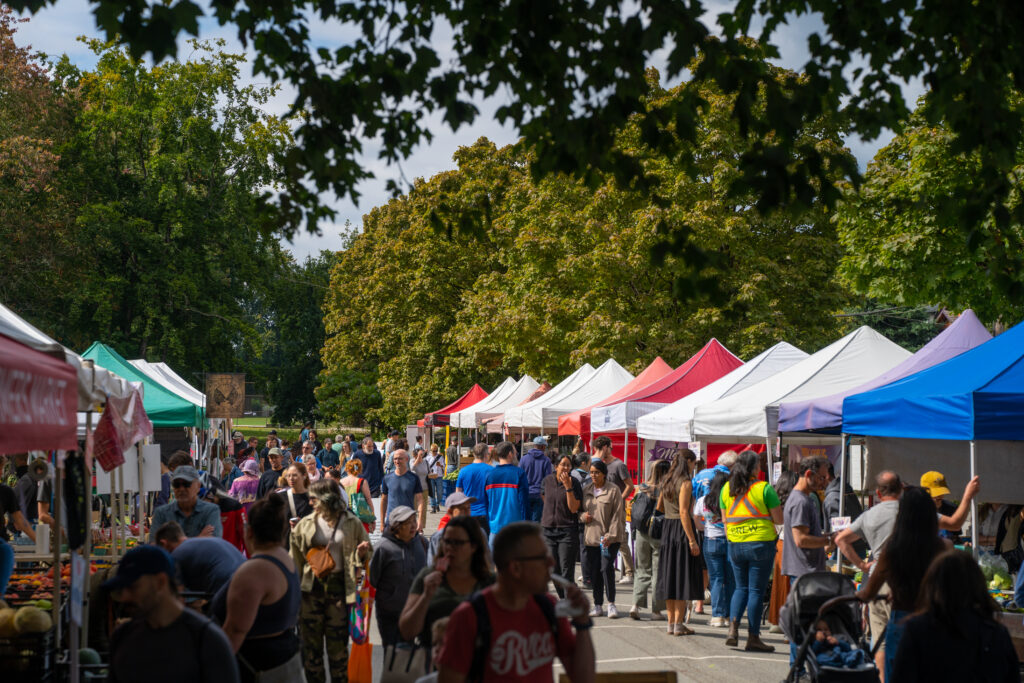
Photo by Geoffrey Tomlin-Hood
On any given market day, the value of farmers markets is easy to find:
It’s in the farmer who knows their customers by name.
The small food business testing a new product face-to-face.
The families, seniors and neighbours who rely on the market as a consistent source of local food.
Farmers markets are where the regional food system shows up at a human scale.
But when it comes to long-term planning and policy, that value isn’t always as visible.
A Plan to Shape the Next Decade
Metro Vancouver is currently asking for public and stakeholder feedback on Food Forward, a regional food system strategy that will guide decisions on food security, climate resilience, emergency preparedness, and local food systems for the next 10 years.
The strategy includes many important priorities – supporting local food production, managing food systems disruptions, reducing food insecurity – but farmers markets are largely underrepresented in the recommendations.
That matters.
Because farmers markets already do much of the work this plan is trying to achieve.
Why farmers markets matter – especially now
Farmers markets are low-cost, adaptable, community-based infrastructure. They can be set up quickly, operate in public spaces, and pivot in response to changing conditions.
They:
- Support farmers and local food businesses with direct, reliable market access
- Improve access to fresh, local food in neighbourhoods across the region
Act as connectors between farmers, residents, nonprofits and local governments - Respond quickly during emergencies and climate-related disruptions
In short, farmers markets are not just community amenities – they are practical tools for resilience.
But if they aren’t clearly named in regional strategies like Food Forward, they risk being overlooked in future policy, funding and emergency planning decisions.
This is where your voice makes a difference
Right now, Metro Vancouver is inviting feedback from residents, farmers and food system stakeholders.
There is a real opportunity to strengthen the strategy by calling for clearer recognition and support for farmers markets as part of the regional food system – not as an afterthought, but as an essential, on-the-ground solution.
Public feedback helps decision-makers understand what’s working, what’s missing, and where there is “low-hanging fruit” to improve the plan.
Take 2 minutes to speak up
If you value farmers markets – whether as a shopper, farmer, vendor or community member – we encourage you to take a moment to complete the feedback form by January 30th.
Your voice can help ensure farmers markets:
- Continue to support local farmers and food businesses
- Are included in climate adaptation and emergency planning
- Have a seat at decision-making tables for the next decade
A few sentences is all it takes to help ensure farmers markets are recognized as part of the solution moving forward. Feel free to use some of our suggested ones below:
- Farmers markets should be explicitly recognized in the Food Forward strategy as low-cost, high-impact food system infrastructure that supports emergency response, climate adaptation, and community resilience.
- Farmers markets are flexible, human-scale platforms that can quickly respond to disruptions by connecting local farmers, residents, nonprofits, and governments during emergencies and climate-related events.
- Stronger policy and municipal support for farmers markets will help activate them as catalysts and connectors within the regional food system, advancing food security, circularity, and resilience at the community level.
For more information on the Regional Food System Strategy process
Thanks for your support!
Vancouver Farmers Markets