Growing the Movement: Markets, Policy, and the People Who Made It Happen
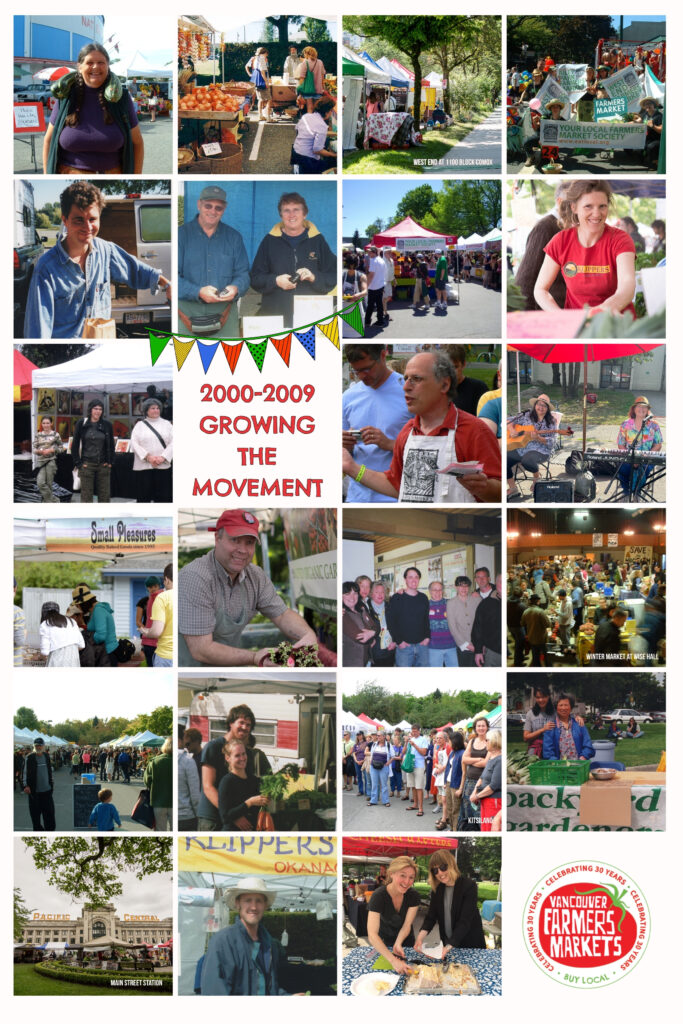
This blog post is Part 2 of our four-part blog series celebrating 30 years of Vancouver Farmers Markets. In the last one, we looked at the early years—from a single market in Cedar Cottage to the first West End pilot. This month, we explore the early 2000s: a decade of growth, experimentation, and the beginnings of real civic influence.
By the time the new millennium rolled in, Vancouver Farmers Markets (then the Your Local Farmers Market Society) had proven that the farmers market model could thrive in the city. But now came the next challenge: how to scale impact without losing the grassroots heart of the movement.
The answer? Grow smart, listen deeply, and embed markets in the very fabric of the city.
A Citywide Market Network Takes Shape
The 2000’s saw VFM move beyond East Vancouver and the West End to establish a true citywide presence. In this decade, new markets launched in:
- Riley Park (2002) – The evolving story of this legendary location begins
- Winter at Wise Hall (2006) – A bi-weekly, indoor take on the winter season
- Kitsilano (2007) – Bringing a market to the city’s west side
- Main Street Station (2009) – A vibrant commuter hub on Wednesdays
Each market brought new communities into the fold—and each location shaped the identity of its market. Farmers and vendors adapted to new audiences, and market managers became not just organizers but community builders.
But VFM wasn’t just growing outward. It was also growing inward.
Building a Movement, Not Just a Market
Behind the scenes, VFM was developing the governance, relationships, and strategy needed to sustain this expansion.
In 2004, VFM played a pivotal role in the creation of the Vancouver Food Policy Council (VFPC)—a groundbreaking advisory body tasked with helping the city advance food security, access, and sustainability. The VFPC gave farmers markets a seat at the table, and opened the door for deeper collaboration between VFM and city planners. The outcome – the Vancouver Food Charter (2007) and that farmers markets were seen not just as “events,” but as infrastructure—part of a larger vision for a just and sustainable city.
Strengthening the Core
During this time, VFM also:
- Established the Vendor Advisory Committee (VAC) to ensure vendor voices shaped decision-making
- Began digitizing operations and experimenting with online communication tools
- Expanded volunteer coordination to keep up with multi-site management
- Built out administrative systems to support growth while remaining a lean, nonprofit team
Market days were still filled with music, fresh produce, and friendly conversations—but they were now backed by policies, partnerships, and long-term thinking.
The seeds planted in 1995 had grown into a system — one that was local, resilient, and becoming increasingly essential.
Up next, we’ll explore the 2010s: a decade of innovation, food access programs, and deep advocacy that reshaped what farmers markets could be.